Services
Nuclear Medicine
Last Updated: September 2026
Nuclear medicine is a medical imaging specialty that uses very small amounts of radioactive materials to visualize and measure how organs and tissues function. Rather than focusing only on anatomy, these studies highlight physiology, how the body is working, so clinicians can detect issues earlier, monitor progression, and tailor therapies. At Akumin, nuclear medicine complements radiology exams such as CT, MRI, and ultrasound by adding functional insights that support evaluation of the heart, thyroid, lungs, kidneys, bones, and more.
Nuclear medicine imaging works alongside Akumin’s radiology services—including CT, MRI, and ultrasound to help identify and diagnose many conditions at earlier stages. By showing how organs and tissues perform, nuclear medicine provides important functional detail that complements the anatomic images from other modalities and supports assessment of the heart, thyroid, lungs, kidneys, and bones. As part of our integrated care, these techniques deliver information that guides timely, accurate decision-making.
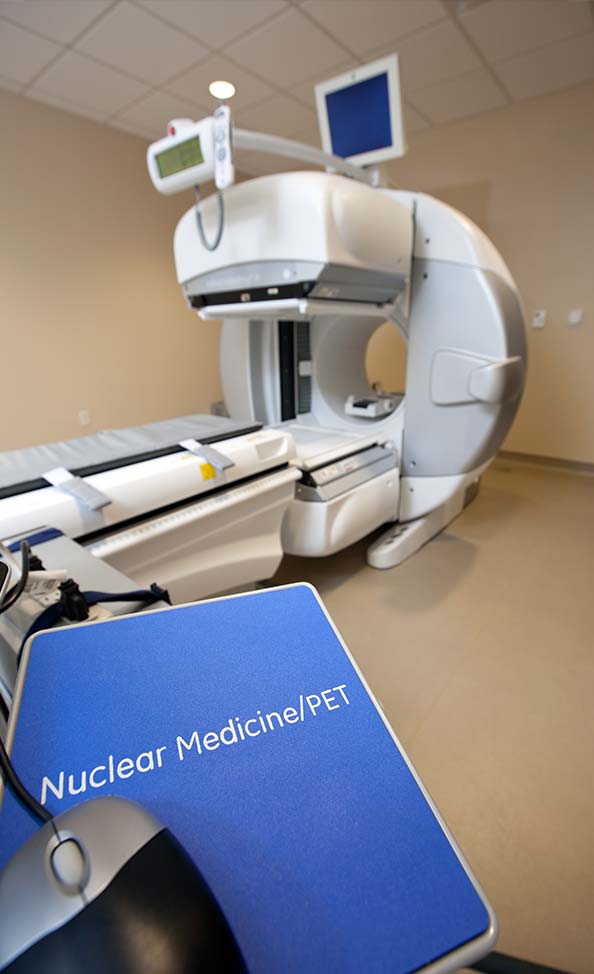 This specialty uses tiny amounts of radiotracers, which may be injected, inhaled, or swallowed, depending on the study. Our care team selects the appropriate tracer and imaging protocol based on symptoms and medical history, often coordinating nuclear medicine imaging with same-day or follow-up radiology exams to provide a more comprehensive view of a patient’s condition. These coordinated approaches ensure that nuclear imaging findings align seamlessly with a patient’s overall diagnostic plan.
As the tracer travels to specific organs or areas of interest, it emits gamma rays. A specialized camera with advanced software detects this energy to create images that reveal how the body is functioning. These images can be fused with Akumin CT scans in hybrid studies (such as PET/CT) to align functional data with precise anatomy, aiding in the detection and assessment of cancers, heart disease, infections, bone disorders, and thyroid conditions.
Nuclear medicine procedures are generally considered safe and are integral to managing a variety of diseases, using the minimum amount of tracer needed to achieve high-quality imaging. Board-certified technologists and radiologists follow stringent safety and quality standards and collaborate across imaging specialties to guide diagnosis, monitor treatment response, and help plan individualized care.